To prepare your Suzuki scooter for winter riding, check the battery, use the engine oil grade your owner’s manual recommends, set tyre pressure weekly, inspect brakes and lights, and warm the engine for one to two minutes before riding. Service the scooter before December at an authorised Suzuki workshop.
By the Khandelwal Suzuki service team, Indore. This guide covers the Suzuki Access 125, Burgman Street and Avenis, and applies to most Suzuki scooters.
Why does winter affect a Suzuki scooter?
Cold mornings thicken engine oil, weaken battery output, lower tyre pressure and add fog and dew to the road. Together, these changes make a Suzuki scooter harder to start and slower to respond. A short pre-winter check fixes most problems before they leave you stranded.
In practice, most winter complaints at a scooter service centre are not major faults. Riders usually report slow cranking, a weak horn or a soft rear tyre. Each of these problems is cheap to fix when caught early.
How should you care for engine oil and fluids before winter?
Use the engine oil grade listed in your Suzuki owner’s manual, since cold weather thickens oil and slows circulation at startup. Replace oil if the service interval is near. Idle the scooter for one to two minutes before riding so oil reaches internal engine parts.
- Engine oil: Check the grade and change interval in your Suzuki owner’s manual. A fresh, correct-grade oil flows faster on a cold start than old, degraded oil.
- Warm-up time: Idle for one to two minutes, then ride off gently. Long idling wastes fuel and does not warm the transmission any faster than easy riding.
- Fuel tank: Fill the petrol tank fully if the scooter sits unused for days. A full tank leaves less air inside, which reduces moisture build-up.
- Fuel stabiliser: Add a stabiliser only if the scooter will stay parked for several weeks.
Expert tip: Skip the five-minute idle habit. A one to two minute idle followed by a smooth, low-throttle first kilometre warms a scooter’s engine and CVT drive faster than standing still.
How do you care for a scooter battery in winter?
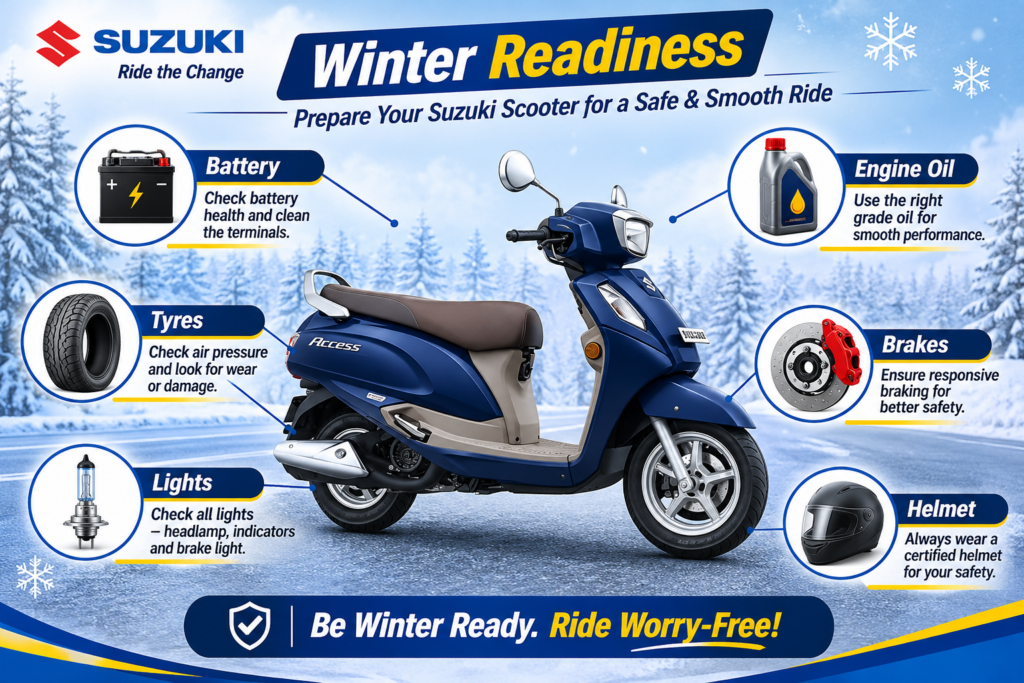
Clean corroded terminals, charge the battery with a smart trickle charger if the scooter sits unused, and replace any battery older than three years. Cold weather cuts battery output, so a weak battery that worked in summer can fail on a winter morning.
A scooter battery is a small lead-acid or maintenance-free unit, and it has little reserve to spare. Winter exposes its weakness first.
- Inspect terminals: Look for white or green powder on the terminals. Clean it off gently and tighten the connections.
- Charge on schedule: Use a smart trickle charger if you ride only on weekends. A battery left idle for weeks loses charge slowly.
- Replace on age: Plan a replacement once the battery crosses three years, or sooner if cranking turns slow.
- Test the electricals: Check the headlight, tail light, brake light, indicators and horn. Short winter days and morning fog make working lights a safety item.
Why does a scooter struggle to start in winter, and how can you fix it?
Scooters struggle to start in winter because of a weak battery, thick oil, a dirty spark plug or moisture in the fuel system. Check the battery first, then the spark plug and air filter. Persistent hard starting needs a workshop diagnosis.
Scooter starting problems in winter follow a predictable pattern. The table below matches each symptom to its usual cause and the fastest fix.
| Symptom | Likely cause | Quick fix | See a workshop if |
| Slow, weak cranking | Aged or cold battery | Clean terminals, charge the battery | Problem returns within a week |
| Engine turns but will not catch | Dirty spark plug or moisture in fuel | Let the scooter rest, retry after a short pause | Starting stays difficult after two or three tries |
| Starts, then stalls | Cold engine, clogged air filter | Idle for one to two minutes, check the air filter | Stalling continues after warm-up |
| Dim headlight, weak horn | Low battery output | Charge or replace the battery | Lights stay dim after charging |
| Rough idle on cold mornings | Old oil, worn plug | Service on schedule | Rough idle continues after service |
Contrarian tip: Do not keep pressing the start button repeatedly. Repeated cranking drains a cold battery further. Wait 10 to 15 seconds between attempts, and check the battery before blaming the engine.
Scooter hard to start on cold mornings? Get a pre-winter check at Khandelwal Suzuki, Indore.
How should you check tyres and brakes for winter riding?
Check tyre pressure weekly because cold air lowers PSI, and confirm the tread is deep enough for wet, dewy roads. Inspect brake shoes or pads for wear before winter, since wet roads lengthen stopping distances. A workshop can measure remaining pad thickness and tread depth in minutes.
- Tyre pressure: Use the pressure printed on your scooter’s sticker or in the owner’s manual. Check it when the tyres are cold, before the first ride of the day.
- Tread depth: Look at the tread wear indicators. Replace tyres that are close to the limit, because worn tyres slip on damp roads.
- Brake wear: Replace worn shoes or pads early. Soft or spongy levers need immediate inspection.
- Brake cleaning: Wash off mud and dust after wet rides, so grime does not build up on brake parts.
What is the step-by-step winter prep routine for a Suzuki scooter?
Prepare a Suzuki scooter for winter in six steps: service the engine oil, test the battery, set tyre pressure, inspect brakes, check all lights, and protect the body. Complete the routine in November, before the coldest weeks arrive. Most steps take only a few minutes.
- Service the engine oil: Confirm the oil grade and change interval in the owner’s manual. Book a service if the interval is close.
- Test the battery: Clean the terminals, check cranking speed and charge the battery. Replace it if it is over three years old.
- Set tyre pressure: Fill each tyre to the manual’s recommended pressure while the tyres are cold.
- Inspect the brakes: Check shoe or pad thickness and lever feel. Replace worn parts before the first foggy week.
- Check every light: Test the headlight, tail light, brake light, indicators and horn.
- Protect the body: Wash, dry and wax the scooter, then arrange a garage or breathable cover.
What is the Start–Stop–See framework for winter scooter readiness?
The Start–Stop–See framework groups winter checks into three layers: Start covers battery, oil and spark plug; Stop covers tyres and brakes; See covers lights, visor and mirrors. Score each layer out of three, and fix any layer scoring below two before riding in fog.
In practice, riders over-focus on the engine and ignore Stop and See. Yet fog and wet roads make braking and visibility the bigger winter risks. Use this checklist and give one point per tick.
- Start 1: Battery terminals are clean and cranking is quick
- Start 2: Oil grade and interval match the owner’s manual
- Start 3: Spark plug and air filter were checked at the last service
- Stop 1: Tyre pressure matches the manual value
- Stop 2: Tread is above the wear indicator
- Stop 3: Brake pads or shoes have enough thickness left
- See 1: Headlight, tail light and indicators all work
- See 2: Mirrors are clean and correctly adjusted
- See 3: Helmet visor is clear and anti-fog treated
How do you protect a scooter’s body and paint in winter?
Wash the scooter regularly to remove dust, dew residue and road grime, then apply a protective wax or anti-rust coating to exposed metal and exhaust parts. Park in a garage overnight, or use a breathable, weather-resistant cover outdoors. Dry the scooter fully before covering it.
- Wash often: Remove grime from the underbody, wheels and brake areas.
- Coat exposed metal: Apply a protective anti-rust coating to bare metal and exhaust parts.
- Rinse after hill trips: Road salt only matters if you ride to cold, hilly regions. Rinse thoroughly afterwards.
- Cover smartly: A breathable cover prevents trapped moisture, unlike plastic sheets.
What should you wear and how should you ride a scooter in cold weather?
Wear thermal layers, a windproof jacket, full-finger gloves and a full-face helmet with an anti-fog visor. Ride slower, keep double the usual following distance, and avoid sudden braking on damp or shaded patches. Cold hands slow your reaction time on the brake lever.
- Layer up: Add a thermal base layer, a windproof outer jacket and insulated gloves. Wear a thin balaclava under the helmet on cold mornings.
- Choose the right helmet: Pick an ISI-certified full-face or modular helmet. Add an anti-fog insert or pin-lock visor.
- Slow down: Cut cruising speed and keep double the usual gap to the vehicle ahead.
- Brake early and smoothly: Avoid hard braking and sudden throttle, especially under trees, near flyovers and on dew-covered stretches.
- Watch for fog: Switch on the headlight early and keep the visor clean.
Where can you get your Suzuki scooter serviced in Indore?
Khandelwal Suzuki offers Suzuki scooter maintenance in Indore, covering oil changes, battery checks, brake and tyre inspection, and genuine parts for the Access, Burgman Street and Avenis. Book a pre-winter service before December to secure a convenient slot. Visit the showroom or call ahead.
Looking for a new scooter instead? The Khandelwal Suzuki two-wheeler showroom in Indore also lists the Access, Burgman Street and Avenis for a test ride.
Key Takeaways
- Battery first: Clean terminals, charge the battery and replace it after three years.
- Correct oil: Use the grade in the Suzuki owner’s manual and idle only one to two minutes.
- Tyres and brakes: Check pressure weekly and inspect pads or shoes before foggy weeks.
- Start–Stop–See: Score each layer out of three and fix weak spots before riding.
- Service early: Book a pre-winter check at Khandelwal Suzuki, Indore, in November.
FAQs About Suzuki Scooter for Winter Riding
Which engine oil is best for a Suzuki scooter in winter?
Use the engine oil grade listed in your Suzuki owner’s manual. Cold weather thickens oil, so a correct, fresh grade circulates faster at startup. Ask Khandelwal Suzuki to confirm the grade for your Access 125, Burgman Street or Avenis.
How long should I warm up my Suzuki scooter in winter?
Idle the scooter for one to two minutes, then ride off gently. Longer idling wastes fuel and does not warm the transmission faster than smooth, low-throttle riding.
Why won’t my scooter start on cold mornings?
A weak battery is the most common cause. Thick oil, a dirty spark plug or moisture in the fuel system can also stop a cold start. Clean the battery terminals and charge the battery first, then visit a workshop if the problem continues.
How often should I check tyre pressure in winter?
Check tyre pressure weekly during winter, before the first ride of the day. Cold air lowers tyre pressure, and the correct value is printed on your scooter’s sticker or in the owner’s manual.
Do I need a separate winter service for my Suzuki Access in Indore?
A separate winter service is not mandatory, but a pre-winter check of the battery, oil, tyres, brakes and lights is strongly advised. Combine it with your regular service interval from the owner’s manual.
Ready for a Smooth Winter Ride?
Book your pre-winter Suzuki scooter service at Khandelwal Suzuki, Indore. [Insert booking link / phone number / WhatsApp number] Our team will test the battery, check oil, tyres, brakes and lights, and get your scooter winter-ready.
MG Road Branch – 9/1/2, Mahatma Gandhi Road, South Tukoganj, Indore – 452001
Annapurna Road Branch – 7-A, Annapurna Road, Opposite Dutt Mandir, Vaishali Nagar, Indore – 45200
Airport Road Branch – 113, Manpasand Colony, Airport Road, Kalani Nagar, Indore – 452006